

Software Built Around How You Work
Custom App Development Built Around Your Business
Medio Street Media designs and develops custom business applications for companies whose processes have outgrown spreadsheets, disconnected tools, or one-size-fits-all software. We build around the way your business actually operates—connecting people, data, workflows, and existing systems into a more efficient digital environment. From internal workflow tools and production tracking to customer portals, reporting dashboards, and software integrations, every application is designed to solve a real operational problem and create measurable business value.

Custom Application Development
When Off-the-Shelf Software Stops Fitting, Build Around Your Business
Most businesses don’t operate exactly like the software they buy expects them to. Teams compensate with spreadsheets, manual data entry, disconnected platforms, email chains, paper processes, and workarounds that become increasingly difficult to manage as the company grows. Custom application development changes that equation. Instead of forcing your operation into someone else’s workflow, we design software around yours. The result can be one centralized system for managing information, coordinating work, tracking progress, communicating with customers, automating repetitive tasks, and giving your team better visibility into what is happening across the business. The goal isn’t custom software for the sake of having custom software—it’s a better way to work.
Workflow-First App Development
We Start With the Way Your Business Actually Works
Great business software starts long before development begins. Our first job is understanding the operation behind the application: who will use it, what they need to accomplish, what information moves between people and systems, where bottlenecks occur, and which repetitive processes can be simplified or automated. We map the workflow first so the technology serves the business—not the other way around. \n\nFrom there, we translate those requirements into an application designed around real users and real processes. That means thinking through user roles, permissions, data structure, interfaces, notifications, integrations, reporting, exception handling, and the steps users take every day. Because Medio Street approaches development through both a technical and business lens, every feature has a reason to exist and every workflow is tied back to an operational objective.
Our Custom App Development Process

Business & Workflow Discovery
We start by understanding how your business operates today. We identify the people involved, the tools they use, the information they need, where work slows down, and which manual or repetitive processes create unnecessary friction. This gives us a clear picture of the business problem before we begin designing the technology.

Process Mapping & Requirements
Next, we translate your real-world operation into defined workflows and application requirements. We map how tasks move from one stage to another, what data needs to be captured, which users need access to it, where approvals or notifications occur, and what the application needs to accomplish at each step.

Application Architecture
With the workflow defined, we design the foundation behind the application. That includes data relationships, user roles and permissions, core functionality, system integrations, automation requirements, and the underlying structure needed to support both current operations and future growth.
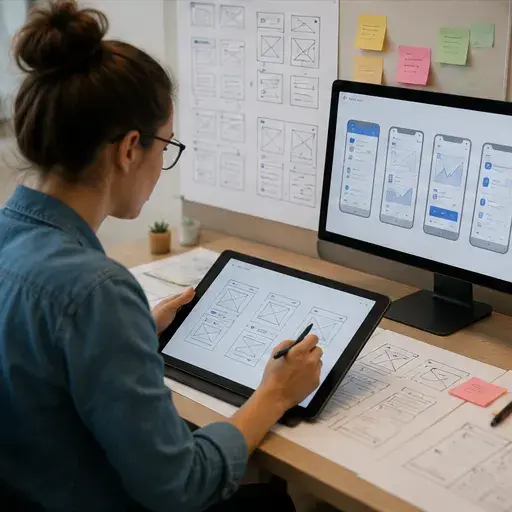
UX/UI Design & Prototyping
Powerful software only works when people can use it effectively. We design interfaces around the tasks users actually perform, prioritizing clear navigation, efficient workflows, useful information, and intuitive interactions. Where appropriate, prototypes help validate the experience before full development moves forward.

Development & Integration
Once the application is designed, we build the functionality that brings it to life. Features, automations, databases, user experiences, and third-party integrations are developed around the approved workflow, with each component working toward the operational goals established at the beginning of the project.

Testing, Launch & Improvement
Before launch, we test the application against real workflows—not just individual features. We verify functionality, usability, data handling, permissions, integrations, and key user paths before deployment. After launch, feedback and real-world usage help identify opportunities to refine the system and continue improving how it supports the business.
One Application. The Workflows, Data, and Tools You Actually Need.
Custom development gives us the flexibility to solve the problems that matter to your business instead of limiting the solution to a predetermined feature list. Depending on the project, we can develop systems for internal workflow management, production and job tracking, customer portals, dashboards and reporting, customer and account management, forms and data capture, inventory or product catalogs, scheduling, process automation, role-based access, and other specialized business functions. \n\nWe can also design applications to exchange information with the platforms your business already relies on—including accounting systems such as QuickBooks Online, CRMs, payment platforms, communication tools, supplier databases, and other third-party services when compatible APIs or integration methods are available. Instead of adding another disconnected tool to your technology stack, the goal is to make your systems work better together.

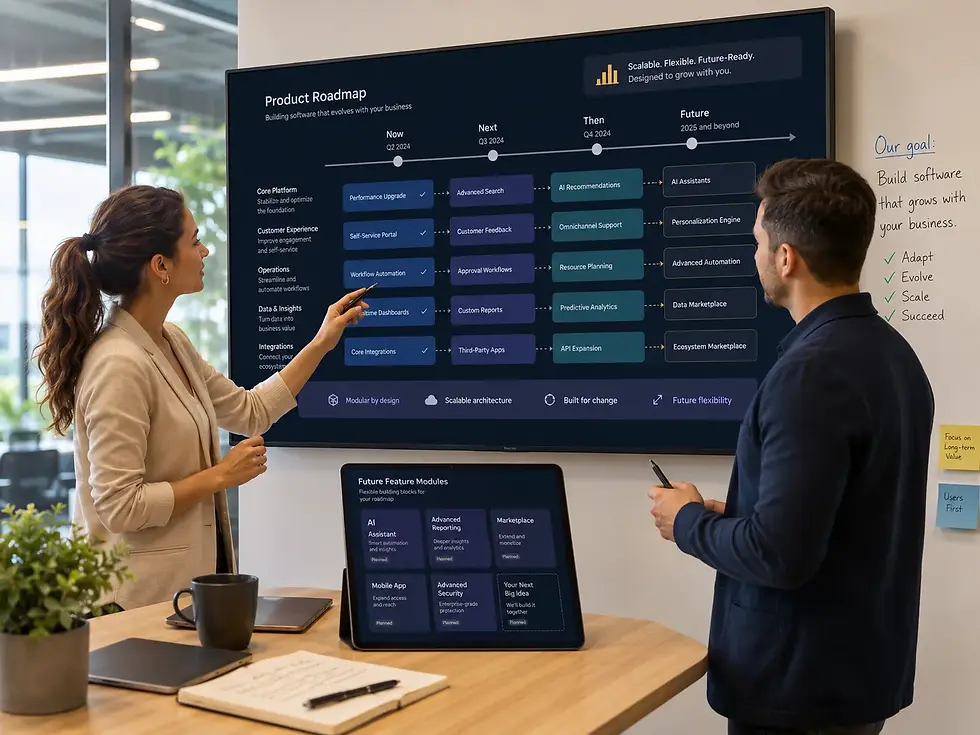
Built for Long-Term Flexibility
Software That Can Evolve With Your Business
Your business won’t operate exactly the same way five years from now—and your software shouldn’t force it to. We approach custom application development with growth and change in mind, designing systems that can be refined as processes evolve, new capabilities become necessary, integrations change, or your team discovers better ways to work. \n\nLaunch is not where we stop learning. Real users inevitably uncover opportunities that aren’t obvious during planning, which is why we value feedback, iteration, maintainable architecture, and ongoing improvement. Whether the next step is adding a feature, automating another process, integrating a new platform, improving reporting, or expanding the application to another part of the business, we want the technology to remain an asset rather than eventually becoming another limitation.
Get In Touch